Monday, October 5, 2009

The Kentucky Potato Cake

As soon as my plane touched down in Nashville I started racking my brain for ways to up my cholesterol level. The Kentucky Potato Cake doesn't have all four of the Southern food groups (sugar, fat, salt, whiskey) but it's decadent enough to be a contender. This recipe was passed down from the Watson side of the family, so it was probably consumed with bourbon.

2 C sugar

1/2 C sweet milk

1 C butter

2 C flour

1 C mashed Irish potatoes

1/4 t soda

2 C pecans

4 eggs, beaten

5 T melted choc. or cocoa

1 t cloves, cinnamon, nutmeg (each)

pepper and salt


Directions: Cream the butter and sugar. Add finely mashed warm potatoes. Add eggs, well beaten, then the milk, melted chocolate, salt, pepper, and spices. Mix and sift the flour and soda. Cut the nutmeats fine and dredge with flour. Add the flour and nutmeats to the batter. Bake in layers in a moderate oven. This is a large cake. Bake in a 325 - 350 degree oven for about 25 minutes, possibly longer. Frost with boiled white icing.

Wednesday, September 16, 2009

On Big Cat Feet


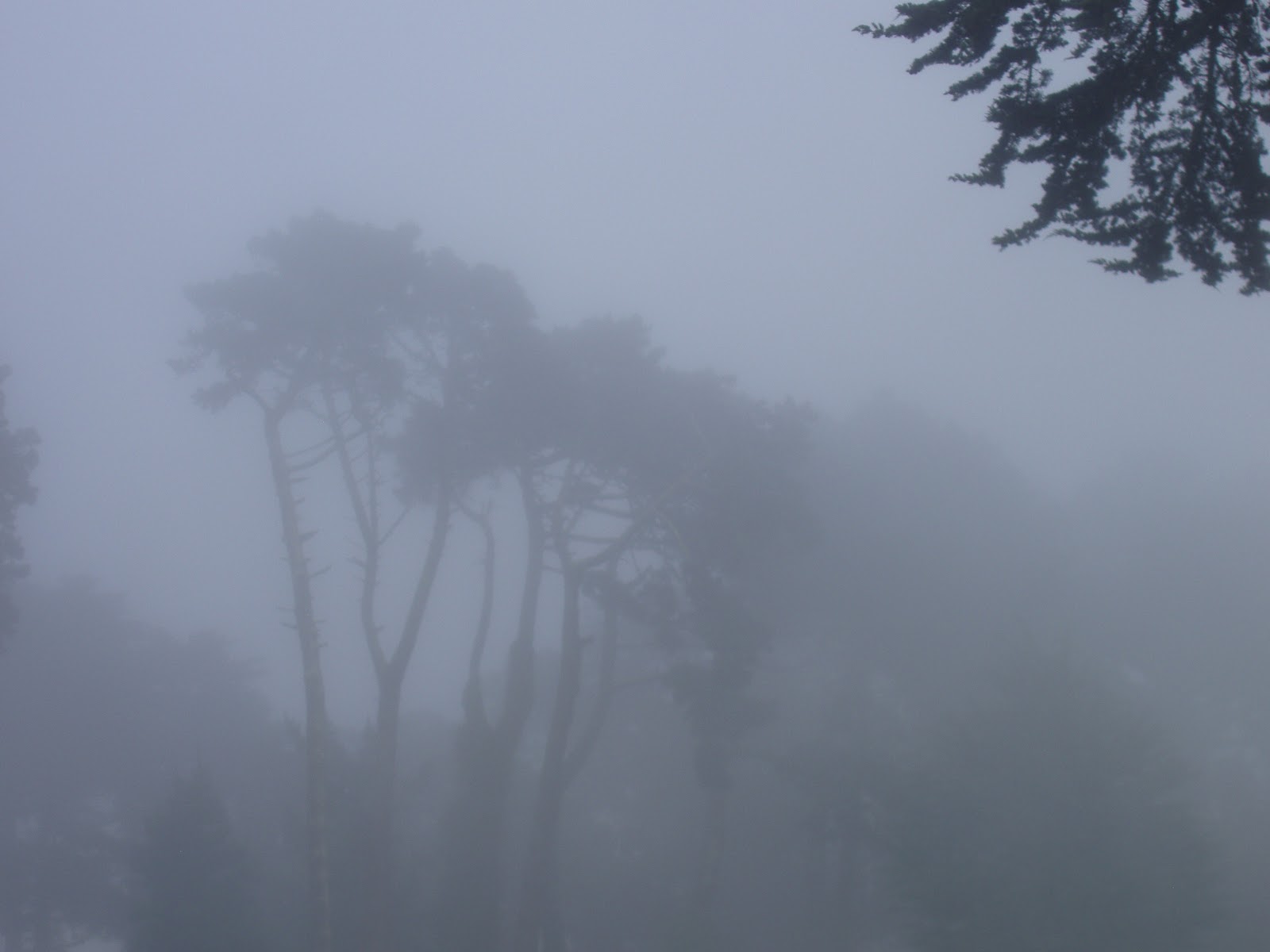
I don't have a hundred words for San Francisco fog--but maybe a dozen. There's the Morning Fog--a high tent of gray that can break to blue. We awaken to white on white, but there's a hint of light in the east and a prevailing optimism that the ceiling will lift by noon.

The Fog of Haves and Have-Nots. This fog is thickest near the ocean (49th avenue) and extends over our house at 21st. Look toward downtown, however, and weep. The dome of City Hall is gleaming in reflected sunlight. We can easily see where the fog line ends. Our friends on 12th avenue (The Haves) celebrate sun from morning till night, but the gray stuff hovers over us all day like a migraine headache.

The most dense, most depressing fog arrives in July and August. This is the Seasonal Affective Disorder (SAD) Fog and it can last weeks. The SAD Fog reminds me of November in Kentucky--days and days of relentless gray. In San Francisco it's triggered by the inland heat. As long as it's 100 in Stockton, this coastal fog will have us by the throat.

When the fog moves in to stay I tell myself--stop whining. Be rational. We wanted to live in The Avenues because this neighborhood hugs the park and extends to the glorious ocean. We can walk (a long walk) to the beach on a Saturday morning, run Cleo in the sand, have a cup of chai at Java Beach, and trudge back through the park...all without getting the car out of the garage. Still...the SAD fog can get really old.

Some fogs are wonderful, such as the Daytime Drama Fog. This random and unexpected fog whisks into the neighborhood on really big cat feet, and floats down alleys and around houses like dense cigar smoke. One minute we can see Balboa Avenue and the next minute it's gone, visibility is near zero, car headlights are on, and even houses across the street have vanished under the white snuggy. This fog cranks up the adrenaline and gives me the same feeling I have when a heavy snowfall moves in to Kentucky. It's a wonder to behold.

When we stand at our front door, 33 steps above the street, we can usually see Golden Gate Bridge and the Marin Headlands in the distance. But sometimes the bridge and bay alone are buried in fog. Look toward Golden Gate and it's not there--all you see is a wide white brush-stroke along the horizon.

This might called the Bridge-Swallowing Fog. These days are fun, too, because they bring the foghorns out. Their leisurely two-note call (a perfect fifth) provides a haunting and beautiful musical score through the day.

Often the Bridge-Swallowing Fog and accompanying foghorns stretch into the evening and turn into the Lullaby Fog. On these nights--which can occur all year round in San Francisco--just open the windows, cover up, close your eyes and listen. The fog keeps the street noise at bay, and the fog horns sing all thoughts into oblivion.

Tuesday, September 15, 2009

Kentucky: Doves

The mourning doves
trail me
from San Francisco
Torn   watercolor, ink, micron pen
light
and haunt
with woodwind notes.

I've lived long
been moved, met
stone,
known sorrow, lost,
been taught, atoned. So

lose me, find me
follow me across
wide pools
plains and ranges,

calling: loss is gain,
truth fluid
that which sears,
which burns to keen
will lift to float
and cool you at the end.

Sunday, September 13, 2009

Opera a la Claudia

Forget the Bolshoi. For us the ultimate Russian experience is opera-– thanks to Claudia.

She’s eighty-ish, the picture of refinement. We met Claudia and her husband John during our first month in San Francisco. Ira was walking on 21st with Cleo and a Russian-accented voice shouted from across the street, “A whippet!"

Within minutes Ira and Cleo had been snagged and pulled up the stairs of the Markevich’s two-story stucco for a discussion of dog breeds, a viewing of John’s wood sculpture, and a taste of Claudia’s torte. So began our friendship and our introduction to L'Opera a la Claudia.

At $80 a ticket, the SF Opera is too pricey for us attend with any regularity. But free performances do come around and we’ve rapidly learned the truth: Claudia must go. In the four years we’ve known them we’ve shuttled her to opera in the park, chauffeured her to Daily City for opera at the cinema, and have spent whole afternoons at John and Claudia’s house with dog, a bottle of white wine, and--opera on the stereo.

The Markevich’s respective pasts could shape a fine libretto. Claudia‘s father was a scholar–-a German linguist--sent to a POW camp in Siberia after World War I. After his release (traveling through China) he met and married Claudia’s mother, a Russian living in China. So Claudia grew up in Asia and as a young adult met John Markevich, another Russian wending his way through China. Their cultural diversity is apparent in any gathering: Claudia understands Chinese, speaks fluent Russian with John, her immediate family and their Russian Orthodox friends, German with her cousins, and English with us. But her favorite language is music.

So today–-free opera in Golden Gate Park–-Claudia is on needles and pins. She has requested we pick her up a full hour before the performance so we can sit with other Russian friends. As she’d predicted, the park is packed. We find the group, claim seats in the white-chair section reserved for senior citizens, and wait for music director Nicola Luisotti to raise his baton. Picnickers crowd around us, and blankets stretch all the way to the hills.

The food is delicious and bountiful, very Russian and very red: cold cuts on crusty rolls, pickled herring with beets, and red potato salad. I contribute stuffed figs and deviled eggs. I miss having green stuff, but they don't.

We eat and share our wine under a white paper sky and silver disk sun. We hum Donizetti's arias, and smile as we recognize O mio bambino caro from Puccini. The notes are like the birds that float and dart overhead, soaring and then vanishing. Claudia is beaming and tapping time. Ira and I turn to each other and just mouthe, “Click” –- or, “wish we could photograph this.”

Friday, September 11, 2009

Ownership

micron 005 on paper


We relentlessly hang on to the Emma House–it’s in the small Kentucky town where all the rest of the family–-five generations–-have lived and died. Our house there is full of memories and stories: the row of daffodils our cousin Emma planted in 1907, the hiding place in the floor of Will’s room, the porch swing where we sang as children.

Being there is bittersweet. Wherever we look we’re reminded that everyone who came before us is gone. Still, my brother and I (living on opposite coasts) return here a few times a year.  When they can get away our grown children come, too. They pile in with guitars, laptops, Blackberrys, and college books, or bringing their own children to repeat the simple routines that have given us a sense of place and permanence.

We’re probably the last generation to be able to keep the house, but letting it go is not in the plan at the moment. With its wealth of history and memory and joy and loss, the truth is–-the house owns us.

Wednesday, August 5, 2009

Family Trees

On the south side, our house can barely breathe. It’s book-ended against a gray stucco owned by our friend, a Chinese-American lawyer with the bipartisan name of Sherman Lee. Sherman’s house begins a stairway of two- and three-story homes that rise from the sidewalk like slabs of Neapolitan ice cream: raspberry, orange sherbet, mint, vanilla.

To the north, subtract fog, power lines, and rooftops for a panoramic view. The Marin headlands set the stage. Against those blues, the onion dome of Holy Virgin gleams golden. Jade-green hills of the Legion of Honor recede in the background. In the distance, orange towers of the Golden Gate Bridge pop against a cerulean sky.


This view would stir almost anyone but I miss the ancient acacia tree that was here when we first arrived.

The branches of the acacia spread to the right and left like a menorah, and its thick glossy leaves shaded and obscured the cluttered yard below our house and the apartment building on the corner. The highest limbs scraped and swayed below our porch windows, transforming that space into a tree house. On a first morning back from Kentucky in the summer I heard the scream of the power saws and opened my porch window to be head-to-head with a sturdy Hispanic tree-trimmer who was balanced in the upper branches.

He worked all day, and I raged. I cursed the sight of streets, gravel rooftops, and bleak interiors that were suddenly in my face. The tree's fate was out of my hands, and as I watched, each branch of the acacia fell. Finally the trunk was sawed flush with the ground.

In San Francisco, trees are loved and hated, and Friends of the Urban Forest will, for a nominal fee, plant the tree of your choice on the sidewalk. They’re responsible for rows of saplings all over the city. In spite of the ease of tree-acquisition, some residents resist. They don’t want the bother of watering during the dry months, or the trouble of raking leaves in the fall.

So some streets have many trees, and others have none. Twenty-first Avenue falls somewhere in the middle with a respectable row of trees on our side and slabs of bare gray concrete across the way.

We joined the effort by planting a tree of our own. Our uphill neighbor suggested that—-for consistency--we stick with the same species of that borders the house below. But there was never really a choice for us. It had to be a ginkgo.

The ginkgo was the tree of my childhood and the two ginkgos that first grew in Clinton had a mythic presence. The oldest was brought to Clinton from the 1893 Columbian Exhibition in Chicago by the chief horticulturist of the fair, a Clinton native whose name was John Samuels. The ancestors owned his rambling white frame house up the hill from my grandmother’s place and long after John was gone the front yard at the Samuels continued to be an expansive showplace for horticultural treasures, notably his great ginkgo.

The second Samuels ginkgo was directly across the street from our house, in impressive sentry to the left of the Fostyr sisters’ front door. This ginkgo was championed by Mom who--as a historian--delighted in its background. As a toddler I was taken across the street and instructed in the design of the fan shaped leaves. I was told that these masters of endurance might actually be male or female. I was schooled in the illustrious history of the ginkgo, and was allowed to cross the street and play in the magnificent shower of golden leaves that would usually fall to the ground in the space of one day.


When I left home I was always informed of the state of the Fostyr’s ginkgo....the unfolding of geometric foliage in the spring and the dramatic and unpredictable downpour of the leaves in October. In a way it was emblematic of my earliest education: the ginkgo provided living lessons in design and history-- studies that would shape my window on the world.

As an adult, my love of the species held fast and I became a Johnny Appleseed of ginkgo trees. As we renovated the Emma House in Clinton I dipped into the budget to buy a large ginkgo and planted it squarely in view of the dining room window. As it grew, my sons and their cousins inferred that the ginkgo was probably our family tree. the kids knew that the ginkgo was our family tree.

A few years later my apartment in Lexington was on Catalpa Avenue but in truth there were no catalpa trees, only a long line of ginkgos planted there by Henry Clay. Several were female trees that dropped foul-smelling fruit on the sidewalk. The medicinal properties of the persimmon-like orbs were lost on me, but I often saw elderly Asian women in hats of straw walking down Catalpa in the morning sunlight, bending to collect the fruit.

By this time the Fostyr sisters had died and their house in Clinton had been replaced by a new Methodist parsonage. A new minister rotated in about every five years, and each was faced with the prospect of dealing with the now-monstrous ginkgo and its offending fruit. Each minister postured and prayed for the demise of the tree, but my mom would not hear of it. If at any time the ginkgo’s future seemed uncertain Mother would quietly approach the minister and inform him of some facts he might have missed: the Samuels family, the Columbian Exposition of 1893, and the great history of the species itself.

Finally the ginkgo across from our house did have to be removed. According to the Methodist minister who did the deed, the Fostyr’s ancient tree was thoroughly diseased, riddled alpha to omega with a deadly plight. I remember the day, the phone conversation with my Mother, and the resignation in her voice as she, too, listened to the screaming of the chain saws.

So....at street level here in San Francisco there is no longer an acacia, but we have planted a slender, slow-growing ginkgo. If we’re lucky it will be at the foot of the steps long after we’re gone. Perhaps some Asian or Russian toddler will notice a golden leaf on the ground. If that child is very fortunate, someone will--as my mother did-- delight in its symmetry, trace the fan-like lines of the leaves, and looking into the child’s eyes will smile and slowly say, “ginkgo, ginkgo.”
_____________
drawings: Fan Leaves
micron 05 and 005 on paper

Sunday, July 26, 2009

The Oakton Mafia


I keep to myself much of the time while I'm in Clinton, rambling around the Emma House, enjoying an airy space that's not available in San Francisco. But Saturday night's sunset brings me to the window, to the back porch, and out to the car.

A left at Clinton's one stoplight and in a matter of minutes I'm on highway 123, windows down, jetting toward Hailwell Corner. The sun is drifting lower and as it falls the light of the sky becomes even more intense; it separates into layers of silver and gold, crimson, purple and blue. An artist's palette.

Another ten minutes and my car is parked at the edge of our soybean field and I am looking across 140 years of family history--rows that vanish into hills. I want to still the sinking sun but in a matter of seconds the field turns from green to indigo, the puddles of water from Wednesday's rain turn dark, and it is time to move on.

The only wide spot in the road between and Clinton and Hailwell is the community of Oakton. It's emblematic of what has become of the rural South-- the railroad crossing is a rise of asphalt. Goldenrod and Queen Anne's Lace wave lazily along the tracks. The abandoned post office is a one room structure on a foundation of concrete blocks, its cashier's desk and pigeon holes for mail are masked by boarded windows. But there are still a couple of churches in Oakton, plus a cluster of homes with carefully tended yards. On this Saturday night there are lights in windows, and a short line of trucks is parked outside what once was once Oakton's general store.

Against the store is a sign that reads "Oakton Mafia." The nearly-empty building is brightly lit and there's a small congregation outside on benches that have been there longer than my lifetime. I slow down. I see a lifted hand....the all-inclusive country greeting that indicates, "Hello, whoever you are." I'm not ready to go home so I slow to a crawl and think about pulling in.

The first to recognize me is Bobby Kelly. Known as the mayor of Oakton, he's a man about my age with a contagious smile and off-beat sense of humor. He may well be the creative force behind the Oakton Mafia sign. It's beyond twilight now but I edge over.

"Looks like the boy's club to me," I say.
"Come on, get out," he replies, and I comply, swinging my rental car into the gravel.

I get out, hug Bobby and then realize I know everybody. It's Bobby and his brother Ricky, Mary Ann and Lucas Deweese, mother and brother of Caleb, our farm manager, and Tracy Workman, whose parents are family friends.

The Kellys are known for their good humor and nonstop conversation and I'm promptly drawn into the mix. In the thirty minutes that follow, the sun completely vanishes and mosquitoes start making a meal of us, but I don't leave. We're all looking at a book of photographs--old school houses in Hickman County-- as we pass around the Oakton Mafia's one pair of shared reading glasses. We talk about family and farm matters with an irreverence that keeps the laughter flowing.

Ricky Kelly asks me how I like San Francisco and I tell him it's too cold this time of year for me. He asks what I do in California and for a moment I grapple for an answer. I tell him I walk the dog, go to the park, handle Kentucky farm business on my computer. I don't think to tell him that I try to write every day, and that I have a love-hate relationship with my tubes of watercolor. In context of this Saturday night these things don't come to mind.

There's a bit of a pause and I look around at Mary Ann and Lucas, Tracy, and the Kelly brothers, getting a handle on what matters most. "I really get homesick for Kentucky in the summer."

Bobby Kelly offers me a popsicle from the cooler inside, but I say I should get going. By that time swatting bugs has become a full-time job. It's been fun, and we say goodbyes all around.

I pull out into the two-lane road and look into my rear-view mirror. There's only blackness where the sunset has been. The Oakton Mafia sign recedes from view. I slowly drive through Oakton keeping an eye out for the scruffy brown-furred dog that often lopes along the center line. Passing through farmland I scan the shoulder for the flash of deer's eyes.

It's a rarity for me to drive this way in darkness, but I'm no stranger to the route. On the road from Oakton I know where I am, what's in front of me and what's been left behind.
_____________
"Sunday in the Shop"
photo by Earl Warren, Jr
.

Monday, July 6, 2009

The Unprecedented Blue

Crater Lake, photo by Ira Simmons
The sudden, unprecedented blue can be explained,
the spectrum pared away, leaving only blue
to dance with electrons in the pure depths,
but it cannot be known, the blue richer than Chartres
that draws the binocular gaze, irresistible and disturbing,
the blue that stares back, like the eye of some god,
through the long lens of the pilgrim who climbs
the splintered rim to find, below the pointing pines,
new angles on perfection, while the still blue enters,
searching among places deeper than the lake,
to sear with what lies beyond camera capture.

(Ira's poem)

Saturday, June 20, 2009

Night Window, San Francisco


Western light is magical. From the north side of the house I can see Golden Gate at the distant right, the shops and homes of central Richmond in the foreground, and Holy Virgin to the left. It's the church that draws me to the window in the evening and I've tried dozens of times to capture it. This shot comes close.

Friday, May 15, 2009

Safe

Ancestor Bundle/Micron and watercolor
We emptied her attic, basement, upstairs rooms,
cubbies behind bookcases.
Linen closet, white-painted
shelves, the medicine cabinet,
neatly labeled under-bed storage cases,
great hat boxes, the hall closet, pop beads,
empty hangers, cards and thank you notes.
.
Unfinished laundry, curled carbon paper,
family photos labeled and unlabeled,
gifts from strangers, her
button box, sheet music. Beneath basement stairs his
shoe polish, black, brown, blood of ox.
Awards and plaques, the ice cream salt.

Taking two years to sort with trowel and sifter,
Every last item designated, consigned, presented, donated,
divided, burned, recycled, restored,

sold, traded, flushed, shredded, consumed.

Until left with only one remaining task:
The Safe.

Hulking on back porch, door ajar
empty but still declaring “this safe is not locked,"
“It contains no valuables,” printed on index card.
And so it sat. My brother and I, facing it off, announced
that Matt Walker of his eponymous auto repair
would move the thing. We asked.

And three months passed.

He was unmoved, it was unmoved.

Until, July. Eyed, measured, wrestled, lifted, hoisted,
hooked, backed and pulled
that dark mass dangling on his wrecker
out through detached back door,
down painted concrete steps
over stones and slowly through the
street to that garage
where we had set pallet of bricks to hold
its considerable weight. And we were done.
Except for ruts behind their house that stretched
from down-spout to hill where pear tree
used to be, for hooking hinges on peeling-paint
door, and for erasing one large unpainted square
shimmering, shimmering on floor of that finally
irrevocably and undeniably empty back porch.

Saturday, May 9, 2009

Local residents launch war on shade

In an move that may spark nationwide interest, residents of this west Kentucky town believe they can-- once and for all --completely rid the town of shade. Beginning in early March, citizens of Clinton, Kentucky launched a grassroots effort to confiscate and systematically destroy all visible tree branches.

J.K. “Rexie” Ross, Clinton cannonizer, is among those voicing support for the effort. “They were everywhere” he said. “You couldn’t see the sky for those things.”

When asked about the origin of the project, most community leaders were stumped.“The idea came from Clinton’s radical core,” one citizen admitted. “But now splinter groups have formed in Fulgham and Water Valley." Oakton has one of the largest limb nullification projects in the area. For weeks at the onset of the project residents worked day and night, abandoning their jobs and rejecting computer and television as “distracting.” Most even resisted cell phone use.

“It’s impossible to log all the hours we’ve given to this effort,” one worker commented. An elderly lady added, "I feel like I've been pulled through a knot hole backwards."

There has been opposition, though largely hollow. One homeowner was seen lumbering aimlessly in his orchard seeking shade. Neighbors believe he has a deeply rooted problem. "He's an indolent sort, certainly not executive timber," one noted.

In this case and others like it, the state department of deforestation takes up the slack, attacking offending limbs with their own bucket trucks and chain saws. The workers are in high spirits. “No hangers in this town,” one barked. “We’ve stripped the place clean.”

With trucks running 24 hours a day much of the tree refuse has been relocated south of town. Once only the size of QE II, the growing wood pile is now roughly the length of Delaware. Ex-zetta Bencini, local journalist, said Clinton residents will bend but never break. “We won’t stop until every branch is gone, ” she said. “This town knows how to stick to it.”

Monday, April 6, 2009

Entrances and Exits

In Clinton, we’ve got location, location, location. The Emma House is at the intersection of two main highways, across from the post office. The library is just a long diagonal away so I know who returns their books.

We’re catty-cornered from Margaret’s Salon and the Gazette Office. Gaze through the beveled glass on our front door and you’re dead-on with the vestibule of the First Methodist Church. Awkward on the Sundays you want to sleep in.

The afternoon of my arrival—first of the spring-- it’s like a Feydeau play, with multiple entrances and exits, pratfalls, and stock characters. I’ve been on my phone from Fulgham on, lining up the cast.

Enter John Turner, Clinton Water Company. Front yard.
We say hi, how are you, and he gets right to it. He locates the water main cover, leans into the hole and rakes away dead maple leaves. I walk out toward the street and watch while he pries the lid off the water main cover and wrenches it open.

Exit Liz. I trek to the basement to turn on the house main and within minutes I hear the blessed sound. Seems like everything is under control. Exit John.

I go from spigot to spout throughout the house making sure nothing is leaking. I flip on the circuit breaker and know it's a short wait for hot water time. After traveling from San Francisco, the first hot shower is a primal pleasure. In a few minutes I check the water temperature. It’s still like ice.

Back to the purgatory we call a basement. Bad, Bad, Bad. Water is gushing under the porch instead of into the water heater. I go upstairs and into the yard. It’s already a marsh. I revisit to the basement and turn the water off, on, off, hoping for a cure.

I stand and think about it. This is not a John Turner problem unless I want the water off. Sooo. I call Lloyd Callison, plumber of choice and leave a message that I have a problem and there’s no hot water. I sound desperate because that’s what I am. But it’s a Friday night, almost dark, and I doubt if he’s looking for work. Exit Liz. To the side yard.

Enter Steve Hardy. Next door neighbor. I can barely see him behind a huge wood stack running the length of the yard. He waves, and we meet in the driveway. We discuss the ice storm, source of all the fallen limbs. .

With a wry smile, Steve asks me if I’ve noticed the condition of my front yard. Sure enough, I have noticed that it is once again full of branches, a surprise to me since I recently contracted with his son Daniel to clean debris left from the ice storm. He explains that the highway department just came along a few hours ago and did another cutting. The workmen left huge branches where they fell—all over the front yard. He asks if I need his help with the current crop. I tell him thanks, don’t worry about it. Exit Steve. Exit Liz . To front yard.

Enter Daniel, Amanda, and Elana. Steve's children. They have come to help me anyway. I’m grateful. We start pulling limbs toward the street. Some are huge and can’t be rolled so we inch them end by end toward the sidewalk.

Enter Steve with the chain saw. Now everybody is working away. It looks like we can finish the job before dark.

Enter David Prince. David was in my high school class. He hasn’t changed a bit. David offers to help. We talk for a few minutes about last summer’s class reunion. He offers to help again. We talk some more and exchange email addresses for photographs. The sun is starting to go down. Exit David.

Steve and his chain saw make short work of the limbs. We finish stacking all the debris at the street, hoping the highway department making a pickup. We have no way of knowing if this will happen. The sun is setting. Exit Steve. Exit Amanda, Daniel, and Elana.

It’s fully dark. I’m hungry but that’s the least of my problems. I go inside and start to make plans for getting the shower I really need by now. My options are limited. I can take a cold shower. I can take a cold bath. I can nuke a washcloth in the microwave and take a bird bath. I can go to a friend’s house for a hot shower. The final option is sounding really good.

There’s a knock at the door.

Enter Lloyd Callison. He’s grown a beard since I saw him last and at first I didn’t know him. He explains that he got my call, is going to be working at this regular job at Goodyear all day tomorrow (Saturday) and will take a look at my plumbing problem tonight. I tell him it’s under the house. He says no problem. I look up and say “Praise God.”

Exit Lloyd. Exit Liz. To the crawl space under the back porch. It is pitch dark now. We shimmy under the house with our two flashlights. He goes first.

In a manner of minutes Lloyd identifies a sag in the pvc pipe that leads to the hot water heater, and it’s obvious that a long strip is split from water puddling in the sag. It looks like a good ten feet will have to be replaced. I start to worry about how much this might cost, but he is also saying that this will be an easy fix. “I do need to go to the hardware store for some supplies,” he says. I look at him blankly. The one hardware store in Clinton has been closed since 5 this afternoon. “Isn’t it closed?” I ask lamely. “Not if you have the key,” he says. Exit Lloyd.

The hardware store is not across the street, but it’s only a block away, in the heart of downtown Clinton. About fifteen minutes pass. I close the door to the back porch and stand there. I am too dirty to go into the kitchen.

Enter Lloyd. he returns carrying two lengths of pipe, some cement, and a new fill valve for the toilet, which I also discovered was leaking. We inch back under the house and I have my flashlight again. I try to light the crawl space without shining him in the eyes. He tries to angle the new length of pipe in place. In a matter of minutes, he’s crawling out backwards, so I have to crawl out backwards too. On the way we are gathering up cement cans, extra pipe, and tools. He comes in and I write him a check for what he says I owe him and then some. He tells me to go to the hardware store tomorrow and pay for the materials. And to call him next week if I need anything. I tell him I doubt if it will be that long. Exit Lloyd.

I take off my hiking boots and leave them at the back door. In the kitchen I peel off another couple of layers, thinking that I will have to sweep the floor already from all the under-house dirt I’ve brought in. I go to the living room and look at the black television screen (it’s not hooked up) and eat some cereal and yogurt while I wait for the hot water heater to work its magic. I could read or play Mom’s piano to pass the time but finally I opt to just do nothing. After a while I test the water in the shower. It’s steaming, so hot I can barely stand it. Close curtain.

Monday, March 16, 2009

Entitlement


Over on Fillmore Street preening
behind plate glass, the sepia-toned
photos in designer lofts,
a brides' bouquet.

They take on airs.


Callas are all created equal,
but thrive in stratified society.
Those in the park: slumdogs
bunched in drainage ditches
or sweet as white birds
in hills of tangled eucalyptus.

Wednesday, March 11, 2009

No Parking. Anywhere.

Never am I more homesick as when I try to find a parking place in San Francisco. A bad parking day in Clinton is when you can’t park at the door of Greg’s market and have to settle for a space closer to the ice machine. Or when a log truck is making a left at the stop light and the prime spot at the courthouse steps is blocked. There are no parking meters in Clinton, just happy, welcoming parking opportunities.

It’s not quite the same in SF. In the first six months of living in the city, I got four parking tickets. OK, maybe five. The first was for parking on the street in front of our house on a street-cleaning day. Our garage was full of boxes and the logical answer was to slide into the space in front of the house. I forgot to read–-or should we say–-interpret the “when you can park here” sign.
Parking tickets in San Francisco are $50.00 across the board, even if you run toward the Despised Meter Person with a fist full of quarters. So next time I needed to park on the street I remembered vividly: Thursday is street cleaning day on 21st Avenue. I had learned my lesson. It was a Friday, so I confidently pulled into a space across the street from our house.

When I came out, I was greeted by a slender white envelope neatly tucked under the windshield wiper. Street cleaning day on 21st is on Thursday on our side of the street, but Friday is Cleaning Morn on the other side.

We have a new rule of thumb on parking. If there is a space available, it is likely illegal to park there. A quarter buys you 12 minutes of parking time most places. If the parking meter is yellow, it’s a loading zone, not for you. If the meter is green, there is a 30 minute limit on parking. This means that no matter how many times you feed the meter, if your car stays parked in that space more than 30 minutes, you will probably be ticketed. The Meter Readers have their ways of knowing.

Our neighborhood is crawling with these little gendarmes. They drive golf-cart sized Meter Mobiles, and peer from their open windows in all directions, hoping to catch someone double parked in front of Viet Nam Cleaner, or with an empty meter at Royal Coffee Ground.

While taking Cleo on a dog-therapy visit to the VA Hospital on Clement I found a space walking distance from the hospital entrance. Magically there were no meters in sight. Returning from my stay, I was all aglow from Dog Based Ministry. This time I had parked in a permit-only space. There were no signs informing me of this, only a “white” mark on the curb. This stripe hadn’t been repainted in my lifetime, and furthermore it was obscured by moss and trash.

Our garage is at sidewalk level so there’s no parking in our own driveway unless you leave adequate space for a walker to pass between garage door and car. Everybody in our hood is aware of this San Francisco quirk, and we leave space accordingly. One morning each resident on our street who parked this way got a wake-up call in the form of a ticket. While we were sleeping the city changed the rules....no parking at all in driveways.

After so many tickets I confided to my husband that I was afraid, as a repeat offender, I might be arrested and hauled into traffic court. I might have to wear an orange suit, not my best color. Have no fear, he said. Bad parking means good things for QuakeVille. I was helping keep Fog City in the black. If that’s the case, then I am San Francisco's new best friend.

Saturday, February 21, 2009

San Francisco: Not Quite


Soaked by February rain

laundry sings

from a balcony on Cabrillo.


Dog whines on leash

and steps tap

syncopated rhythm


Look up

walk smart

leap sidewalk Mary


It's wet season in the Richmond

and we are

not. quite. gentrified.

Wednesday, December 31, 2008

San Francisco: December 31

The last fog of the year
make lists
collect remnants
of Christmas meals, chop, bag
mince for an audience of one

Stir up tortilla soup,
cut cilantro, yellow squash,
vidalia and

at last

the piano
play (badly)
and know
enchantment lives
between
the sharps and flats.

Tuesday, November 4, 2008

Kentucky: The Day We Sang


That summer, we sang. We were too far from Washington to march, we were too far from Birmingham to mourn. We were too far from Chicago to carry a sign. So we did what we could, we sang.

I was starting my junior year in high school, just feeling the adrenaline: we were on the cusp of a new day.

I have that feeling now, today, as I watch a record number of voters coming to the polls. By tomorrow we may have elected our first African-American president.

I think many people voted for Barack Obama not because of his race, or in spite of his race. He's a charismatic, idealistic candidate who restores that sense of hope, that adrenaline rush that I remember from the songs, and the causes to sing for.

Of the four of us who sang that day, three have lived to see this moment. As the years passed we've witnessed too much: the agony of Vietnam; the Kennedy and King assassinations; September 11. We've all gone in different directions, but I'll wager that my friends would agree: today we remember. Today we remember how it felt to sing.

photo: Franklin Stone, David Sensing, Liz Jewell, Cherry Darby

Wednesday, October 22, 2008

The Cardboard Truck


It's part of the Geary Street drama, the cardboard recyclers.

Accordion on wheels
the cardboard truck
turns on Anza and moves up 21st

Flying fingers of cardboard man
and brittle brown wife weave dry stacks
in horizontal layers–their mesa
grows skyward as seamless day ascends

and light slants --

and soft fog bellows from Ocean Beach.
The load groans toward Geary,
hovers at the crosswalk,

bent woman, piercings, baby backpack
a short processional moves by

he watches, flint-faced, then leans,
strikes blindly toward the seat beside him
and
celebrates sunset
by lighting up.


Tuesday, October 21, 2008

At Stern Grove


We made camp
high
among redwood trees
Puccini and pasta
on the slope

while below
golden hatless heads, quilts,
a hundred paper fans
moving

like butterfly wings.

Monday, October 20, 2008

How to Taste Edamame

Erase that Kentucky field
sunshot August morning
clay cracking, shaded by hearty green just

tackle the here and now

and holding by tail
pop salted pod into mouth
draw through teeth
as you would the artichoke then

close eyes and let the pearls delight you
breathe deeply hear first foghorns
held at Bay

then go back.

South Columbus
at margin of the long field
reaching toward September twist the stem
and
roll dirt-colored husk with thumb it

splits
you taste the little pebbles. If they give way just
toss the pod--

not ready for harvest yet.

Wednesday, July 30, 2008

No, It's a Whippet


When we leave San Francisco, Cleo stays there. This is one of the few kinks in our otherwise manageable lifestyle.

We've thought of bringing her on board disguised as an ugly baby. We have, in fact, debated every way to get her to Kentucky...other than stashing her in the cargo hold of our plane. Our lives aren't quite right without her.

Whippets are indeed the best kept secrets of the dog world. When I decided to get a dog, I began with a dog search engine. Sims and I entered all the significant adjectives: medium-sized, short-haired, quiet, gentle. No yappy dogs need apply. The answer came back the same each time: Whippet, Whippet, Whippet. I couldn't remember what a whippet looked like. Sims vaguely remembered the lanky hounds from reading the encyclopedia as a child.

Though her moods are mercurial, she's never disappointed us. We start the morning before Cleo does, particularly during San Francisco's foggy season. At daybreak she's usually sleeping soundly between us, having migrated there when we're in our deepest sleep. Later she'll lope to her chair and curl there like a brindle doughnut. With no padding whatsoever, she's always hunting a warm spot.


Heat-seeking, yes. A heat-seeking missile. The sound of leash-janglings transform her. In a flash she's at the door, ready for a sprint. As she loops in circles at Marx Meadow we continually explain: No, she's a whippet. this is our mantra as again and again passers by comment on her greyhound-ness. Whippets, in fact, were bred from runty greyhounds. Their lines stretch back to Egypt, and in Wales they were considered the poor man's greyhound--chasing rabbits for food and competing in spontaneous speed-matches.

When she's off-leash at Ocean Beach, she becomes Miss Congeniality. She flirts with small dogs, big dogs and occasionally meany dogs. When black labs bound into the surf she follows, the fabric of her dog-limbs translucent and kite-like. My heart stopped once when she racead away from me and sprinted alongside two horse-drawn sulkies trotting at low tide. It was like a scene from The Iliad, our graceful sight hound bounding beside the chariot racers. I was terrified for her, but transfixed by the timelessness of these graceful moving forms backlit by the sun.

When I'm in Kentucky I miss her amber eyes, too light to qualify for breed standard; I miss her occasional (and intentional) vocalizations--too speechlike to be considered barks. Most of all I miss her gentle spirit and ethereal nature--she enters the room as quietly as a shaft of light.

Friday, June 27, 2008

The Basket Case

Today, another oppressive fog. Or smog, from the fires north and south. The Dow plunged. A barrel of oil reached a new high. When the mail came, our water bill was $833.99, which--yes--we're looking into. So I've retreated into the baskets. The Dale Chihuly baskets I saw at the De Young Museum yesterday. The magical baskets.

To describe the installation is like trying to recreate water or heat. Or like trying to explain intuition or a fleeting memory. There was darkness, there was light, transparent color, there was one floating form, and then another. I believe it was Sontag who said photography is a secret within a secret. I felt the same about the line of baskets, with their sister baskets, woven, incised, stacked, nested, cradled. They were like bubbles of a past I couldn't quite grasp. Like a word I could see but couldn't recall.


I remember my father coming back from the farm with an arrowhead in his hand. I remember standing by the little mound of earth in the woods and knowing that underneath there were pot shards and charred bits of some past lifestyle, but to scrape beyond the surface would somehow mar the moment as well as the past. This is how I felt when I saw the baskets, warped, cradled and stacked--they were a reflection of a reflection. I wanted to cry for a memory that I couldn't possess but could filter through my hands, just for an instant.

At home, I checked my email and learned that a tree had fallen on one of the rental houses in Kentucky. Cleo was crying for a walk in the park. There was dinner, the gym. But I was lost along the cradled baskets, in a color called 'tabac,' a woven line, following a link to nowhere and everywhere.

Tuesday, January 1, 2008

On the Fault Lines

It starts as a soft rocking, a silent vibration. Before daybreak the mind answers impulsively and irrationally–-a storm is testing the windows, the dog has leapt on the bed. Then realization rights itself and opens like a book: we’re having a quake.


Photo by Earl Warren, Jr.
When these tremors wake me from a sound sleep I could be at either of the places I call home, since both sit above separate and major fault lines. My life is divided between San Francisco, on the San Andreas Fault, and the ragged western corner of Kentucky, on the New Madrid.

Kentucky is where my sons are, and it’s the place I’d choose in the event of the big rumble. The county of my childhood is wedged into the southernmost corner of the far end of the Jackson Purchase. It's in the South, but in the northern South, a place of sweeping fields and grassy hills where, during the Civil War, some wore blue and some wore gray.

The course of the Mississippi River defines the western perimeter of Hickman County and forms the edge of the state as well. So besides being where North meets South, it’s where East meets West.


The river is a fickle boundary. Threeponds, a low, cypress-rich hunting ground south of Columbus, was once bisected by the river before the channel shifted to the west and left behind a trio of slender and connected pools. The curving sandbars of Bessie Bend are visible today but might be gone tomorrow. Wolf Island was orphaned by the river, distanced from Kentucky by its fierce and unrelenting course.

Kentucky would be a more tidy, more geometric state without this trapezoidal, sparsely populated, end-of-the-universe county of ours. It doesn’t have the stately elegance of the Bluegrass, but what’s missing in polish is recouped in drama. Balance atop the chalk cliff at Columbus and take in the breakneck, almost perpendicular drop to the rich mud and gravel of the river’s shoreline. Look below and beyond, past tug boats, stray logs, and swirling eddies to see a sweeping, hazy, green and lavender watercolor of Missouri farmland.


As kids we climbed crab-like down the bluff and skipped flat rocks along the murky waves.  The shoreline offered up wet chunks of clay and we let it ooze between our fingers, merging veins of ochre, tan, and red.  We walked barefoot at water’s edge, scanning brown-sugar sand for sharp rocks and glittering shards of glass. In time we headed back toward the bank and made our way upward, gripping saplings and bare tree roots, and sometimes pausing to swing in the knotty cradle of a grape vine rope.

Swimming in the river was not allowed. There were currents that could pull a child to the bottom and under-tows that lusted for the most experienced swimmer. Stories of man-sized catfish added to a river mythology owned by every boy and girl who grew up near the shore.

There’s no bridge, no ferry now,  but the banks of Columbus have hosted a wealth of real and imagined travelers. The earliest mound-builders stole along the water’s edge, as did the Chickasaws. Marquette brought religion downstream, accompanied by the fur-trading Joliet. Confederate soldiers struggled to stretch a great chain across the water, hoping to deter the path of Northern gunboats. Cotton from Vicksburg and Memphis floated up the river along with steamboats carrying the raucous jazz of New Orleans.  And we all believed when Huck and Jim left home they poled along the mile-wide course that we knew well.

To live near the Mississippi is to ever be reminded of forces larger, greater, grander than ourselves. It’s a stern parent, always in charge, a force of nature, God, or pantheistic blending of the two. Stand at water’s edge and learn life’s contradictions: it beckons us, then leaves us on the shore. 


In San Francisco, a half mile from the vast Pacific and firefly lights of Golden Gate,  I still feel the pull of the Mississippi. I see it clearly: it’s dusk. The empty barges seem to defy gravity. The water is a broad slab of glass that mirrors the sky.